

The business case for an EV charging station depends on more than the price of each kilowatt-hour. Solar, battery storage and intelligent control can help operators manage the costs that are often hidden behind the electricity bill.
Is your charging station paying only for the energy delivered to vehicles?
In many cases, it is also paying for when that energy is used, how high the site’s demand rises, how much grid capacity must be reserved and whether the existing transformer can support expansion.
Consider a busy charging window. Several fast chargers start at the same time, pushing site demand far above its normal level. Even if that peak lasts for a short period, it may trigger a demand charge, exceed contracted capacity or expose the limits of the existing transformer. Meanwhile, solar production may be highest several hours before the vehicles arrive.
This mismatch between energy availability and charging demand is one of the main reasons operators are evaluating PV EV charging stations with battery storage. The objective is not simply to add more equipment. It is to control when the site imports, stores and uses energy.
The Hidden Cost Stack Behind EV Charging
Charging-station economics are often discussed in terms of the cost per kilowatt-hour. That number matters, but it does not show the whole picture.
Energy charges
The station pays for electricity imported from the grid. Under a time-of-use tariff, the same amount of energy may cost more during peak hours. A charging schedule concentrated in those periods can quickly narrow the margin between the electricity purchase price and charging revenue.
Demand and contracted-capacity charges
Some commercial tariffs also charge for the site’s highest power demand or for exceeding an agreed capacity. This means a brief period of simultaneous charging can influence the bill for an entire settlement period.
Grid connection and expansion costs
What happens when the charging business is ready to expand, but the transformer is not? The site may require a network study, additional switchgear, transformer reinforcement or utility construction. These costs can be significant, and the approval process may delay new charger deployment.
Operational constraints
A power-constrained station may have to reduce charger output or limit simultaneous sessions. That can increase waiting time and leave valuable charging assets underused. Separate platforms for PV, storage and charging can also make monitoring and fault diagnosis more difficult.
For owners and investors, the important question is therefore broader: How can the site deliver more charging service without allowing grid demand and infrastructure costs to rise at the same pace?
How an Integrated PV BESS EV Charging System Responds
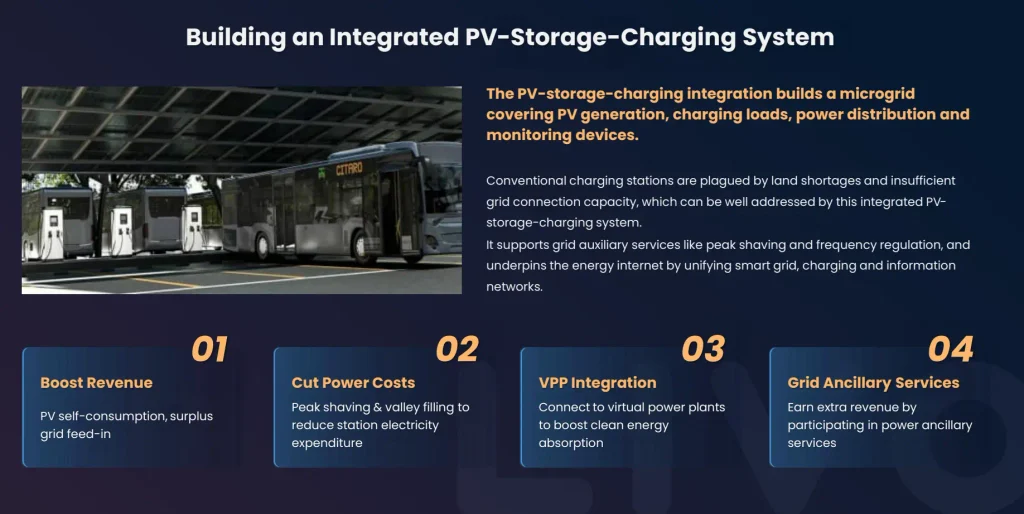
An integrated solution combines photovoltaic generation, a battery energy storage system, EV chargers and an intelligent energy management system. The iEMS monitors solar production, battery state of charge, charging demand and the grid connection, then coordinates how power moves through the site.
Each part of the system addresses a different piece of the cost stack.
- Use more solar energy at the charging station
When vehicles charge during daylight hours, PV can supply part of the load directly. This reduces the amount of electricity purchased from the grid at that moment.
But what if solar generation peaks before the main charging period? The BESS can store eligible surplus solar and make it available later. This increases solar self-consumption and can be more valuable than exporting the same energy, depending on local feed-in rules and electricity prices.
A small solar PV EV charger may serve a limited number of vehicles. At commercial scale, the value comes from coordinating solar production across multiple chargers and charging windows.
- Control the highest demand peaks
During a high-load period, the battery can supplement the grid so the station’s grid demand remains below a defined target. This is the basic principle of peak shaving for EV charging.
The iEMS can also allocate available power across chargers. Instead of allowing every charger to draw maximum power at the same time, adaptive charging responds to vehicle demand, site priorities and the available grid capacity.
Effective peak shaving requires both adequate battery power and adequate duration. A battery may cover the first few minutes of a peak but still fail to control the full event if its usable energy is too low. That is why battery sizing must reflect the site’s actual load curve rather than charger nameplate capacity alone.
- Move energy into higher-value charging periods
When off-peak electricity is cheaper, the BESS can charge during the lower-price window and discharge when grid electricity is more expensive. This load-shifting strategy can work particularly well for bus, taxi and logistics fleets with predictable charging schedules.
The calculation should include battery losses, operating limits and degradation. It must also account for any energy reserved for backup or the next demand peak. The same battery capacity cannot be counted twice in the business case.
- Support expansion within a limited grid connection
Battery-buffered charging allows the station to serve a controlled load above the instantaneous grid limit. The grid provides its permitted share, while the BESS supplies the difference for the required period.
This can help an operator add charging capacity without waiting for an immediate transformer upgrade, subject to site engineering and local utility requirements. It can also support more simultaneous sessions and improve charger utilization.
The Control Strategy Should Match the Charging Scenario
There is no single operating schedule for every charging station.
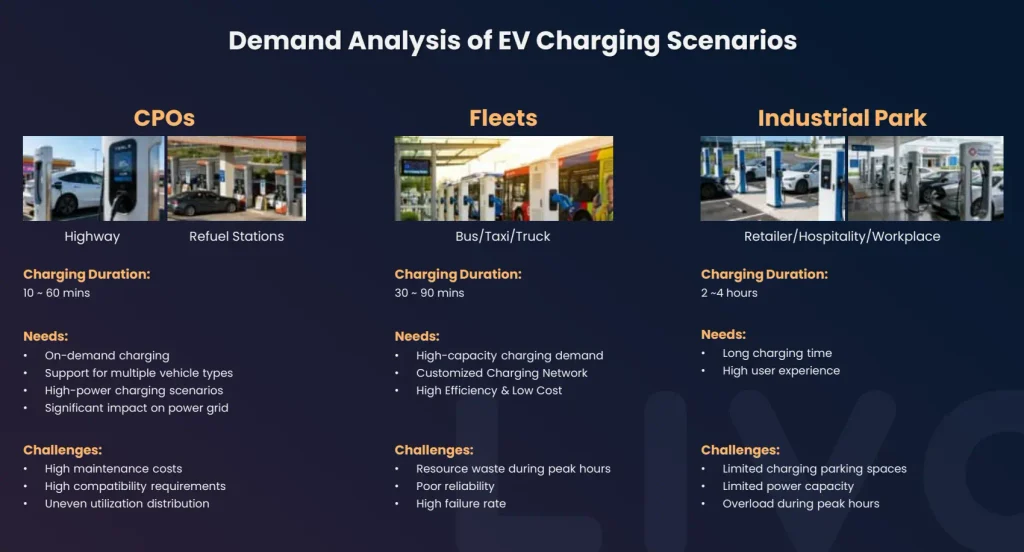
A public fast-charging site must respond to uncertain arrival times and protect driver experience. A bus depot may have concentrated charging windows linked to route schedules. A workplace or retail site often has longer dwell times and more flexibility to align charging with daytime solar production.
The strongest operating priority may therefore differ by site:
- A highway charging operator may prioritize charger availability and management of sudden demand peaks.
- A fleet depot may prioritize off-peak charging, load shifting and departure readiness.
- A workplace or commercial site may prioritize solar self-consumption and gradual power allocation across parked vehicles.
- A site with limited transformer capacity may prioritize demand control and battery-supported expansion.
The equipment provides the capability. The iEMS operating logic determines how that capability supports the business model.
What This Looks Like in Real Projects
Electric bus charging in São Paulo
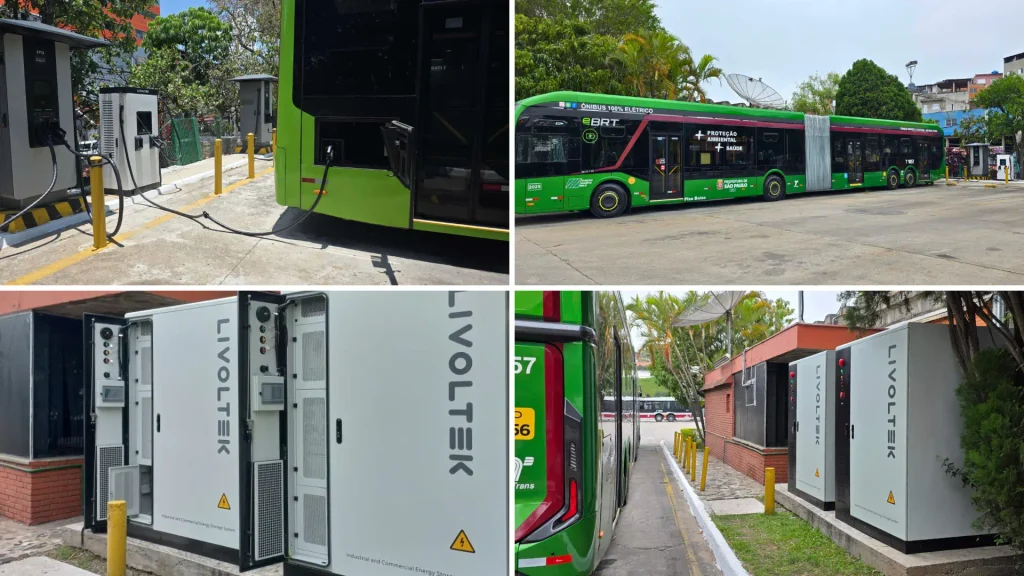
A São Paulo electric bus charging project pairs 180 kW of charging capacity with a 200 kW/450 kWh BESS. The battery stores energy during lower-demand periods and supports the charging load when demand rises.
For the depot, the value is operational as well as financial. The system helps multiple buses charge while the site manages contracted demand, reducing dependence on an immediate grid upgrade and supporting more controlled energy use.
Solar, storage and charging in Cyprus
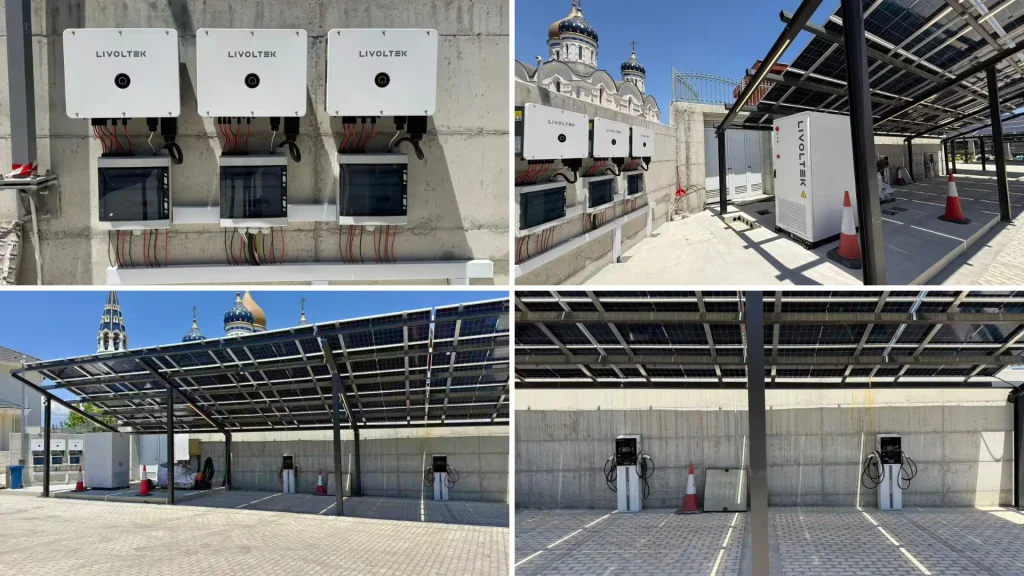
A church project in Cyprus combines three LIVOLTEK GT3-60K grid-tied inverters, one 125 kW/261 kWh energy storage cabinet and two 22 kW BUSH AC EV chargers. Intelligent iEMS control coordinates solar self-consumption, peak shaving and load shifting while retaining backup power for priority facilities.
The two projects have different users, charging patterns and operating priorities. Both demonstrate why an integrated design can create several forms of value from the same system.
Where LIVOLTEK Fits Into the Solution
LIVOLTEK’s PV BESS EV charging station solution brings energy generation, storage, charging and digital control into one architecture. A project can combine GT3 series commercial grid-tied inverters, BES-P125X261 or BES-H60X120 energy storage, MotionFast 60-240 kW DC charging stations, metering and communication equipment, LIVOLTEK Cloud and the My LIVOLTEK app.
The system supports centralized monitoring and intelligent scheduling across PV, the BESS, charging loads and the grid. This reduces the operating complexity created by disconnected equipment and separate monitoring platforms. It also gives EPCs and operators a clearer foundation for commissioning, daily operation and maintenance.
Depending on the project, the iEMS can prioritize solar self-consumption, peak shaving, time-of-use load shifting, demand control or backup reserve. Optional value streams such as surplus feed-in, virtual power plant participation and grid services must be evaluated against local market rules.
Five Questions for a Credible ROI Assessment
Before discussing a standard savings percentage, a charging-station owner, investor or EPC should answer five questions:
- When do vehicles arrive, and how many charge at the same time? Interval data and realistic session schedules reveal the size and duration of the site’s peaks.
- How does the electricity tariff work? The model should separate energy prices, time-of-use periods, demand charges, capacity penalties and export compensation.
- What is the real grid constraint? Confirm transformer capacity, the agreed import limit, interconnection requirements and the cost and timing of reinforcement.
- How much solar generation can the site use directly? Compare the hourly PV profile with the charging load and available installation area.
- Which service requirement must the battery protect? Define charger availability, departure schedules and backup reserve before assigning battery capacity to cost optimization.
A credible model should compare conservative, expected and high-demand scenarios. It should include energy losses, battery degradation, maintenance, downtime and replacement assumptions. Most importantly, it should show where the value comes from instead of hiding everything inside one headline payback number.
The Real Opportunity Is Coordinated Energy Use
PV and battery storage do not lower charging costs simply because they are installed next to the chargers. They create value when the system uses solar at the right time, controls grid demand across the full peak, protects charging service and matches battery capacity to a measurable site constraint.
For charging operators, this can mean lower exposure to peak electricity costs and better use of existing grid capacity. For investors, it creates a clearer link between energy strategy and charger utilization. For EPCs, it provides an integrated approach to electrical design, controls and long-term operation.
Are you planning a new PV EV charging station or expanding an existing site?
Share your tariff, interval meter data, charger schedule, grid limit and available PV area with LIVOLTEK. Our team can help assess the right combination of PV, BESS, charging and intelligent control for your project.