

As electric vehicle charging sites grow, installing more chargers is only part of the challenge. Operators must also confirm that the site has enough electrical capacity, control peak demand, use renewable energy effectively and coordinate equipment from different energy subsystems.
A solar EV charging system addresses these needs by integrating solar PV, battery energy storage and EV charging under coordinated control. Often called a PV storage charging system, it can direct locally generated solar power to vehicles, store surplus energy for later use, supplement the grid during short demand peaks and manage the site’s total grid import.
The result is not simply a collection of products. It is a coordinated site energy architecture designed around the charging profile, grid connection, electricity tariff and operating priorities.
What is a solar EV charging system?
A solar EV charging system combines photovoltaic generation, a battery energy storage system (BESS), AC and/or DC chargers, power distribution, metering, communications and an energy management system (EMS). The EMS monitors power flows and applies operating rules so that generation, storage, charging demand and the utility connection work together.
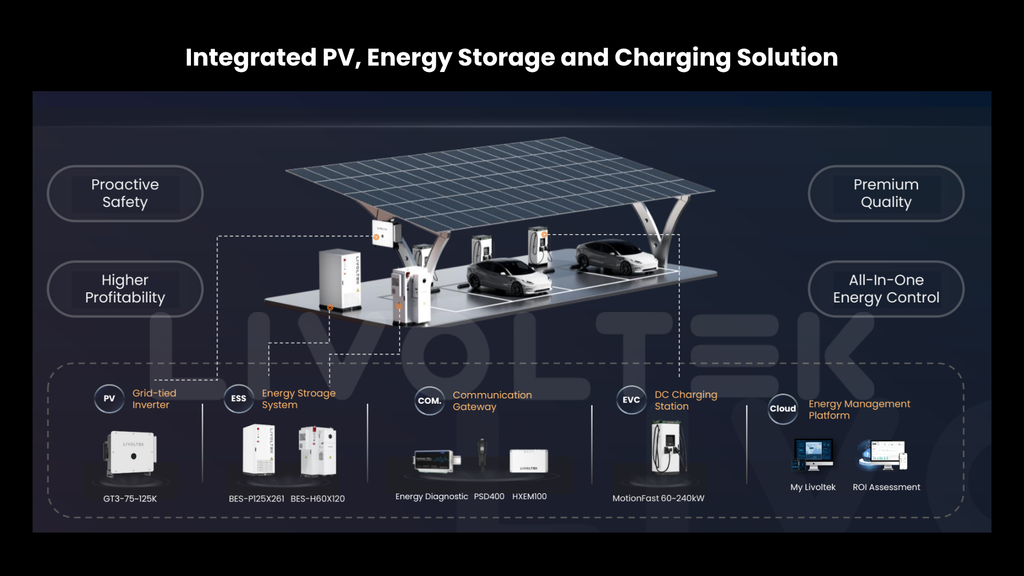
The main elements are:
- Solar PV modules and inverters
- Battery energy storage and a bidirectional power conversion system
- AC chargers, DC fast chargers or a combination of both
- Transformers, switchgear, protection and site distribution
- Meters, sensors and communications gateways
- A local EMS with optional cloud monitoring
This arrangement can operate as a grid-connected energy system. With the required grid-forming equipment, isolation devices, protection scheme and control logic, it may also support backup or off-grid operation. A PV-plus-storage charging site should not automatically be described as an EV charging microgrid unless it has been designed and approved for those functions.
How does a solar EV charging system work?
Power can move through the site in several ways, depending on solar production, charging demand, battery state of charge, electricity prices and grid limits.
- Use solar power locally. When PV generation and vehicle demand occur at the same time, solar energy can serve the chargers and other site loads before additional power is imported from the grid.
- Store surplus solar energy. If PV output exceeds current demand, the battery can absorb available surplus energy. Depending on the interconnection agreement and tariff, the site may also export power or curtail generation.
- Support a charging peak. When several vehicles charge simultaneously, the BESS can discharge on the load side of the grid connection. This helps keep grid import within a configured limit and enables peak shaving for EV charging.
- Shift energy across time. The battery may charge during lower-cost periods and discharge when electricity prices or site demand are higher, subject to the dispatch strategy and battery operating limits.
- Coordinate charger power. EV charging load management can distribute available power among charging points according to vehicle priority, departure time, required energy or service-level rules.
- Respond when solar output falls. In the evening or during poor weather, the grid and battery can continue supporting charging. Backup operation during an outage is possible only when the electrical architecture and controls have been designed for islanded operation.
This coordinated approach makes solar powered EV charging more useful throughout the day, rather than limiting it to the hours when PV generation and vehicle demand happen to overlap.
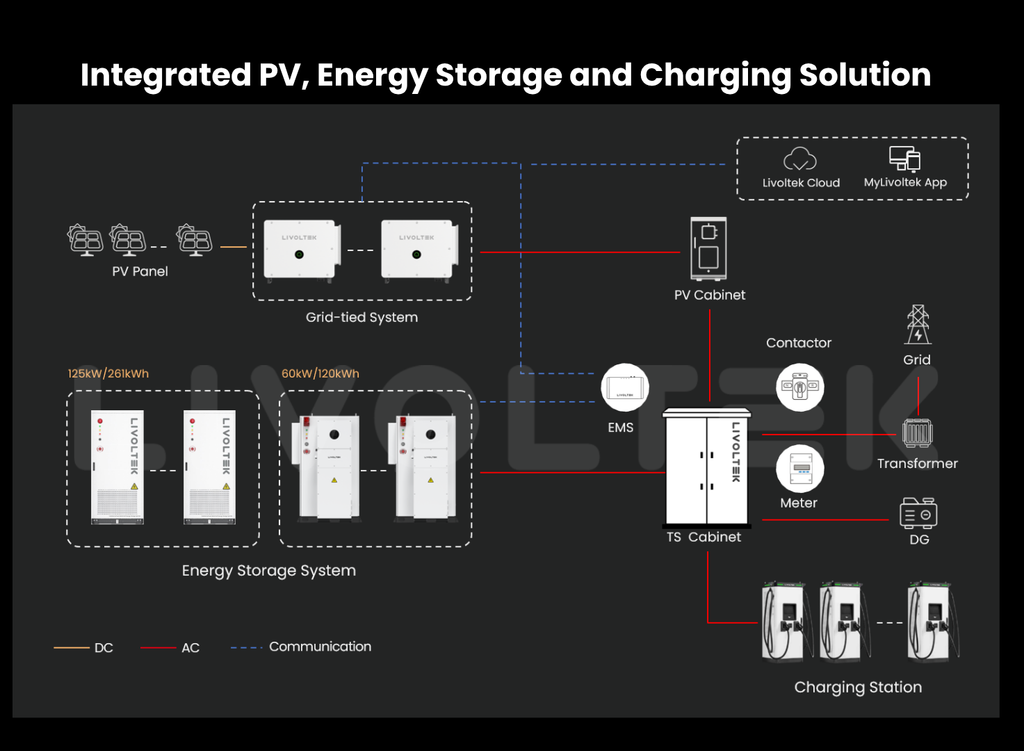
The five core elements of an integrated charging site
Solar PV and grid-tied inverters
Solar PV modules generate electricity close to where it will be used. Grid-tied inverters convert the modules’ DC output into AC power and connect the array to the site’s electrical distribution system.
When charging demand is present, locally generated power can reduce grid imports. When demand is low, available solar energy may charge the BESS, serve building loads or be exported, depending on the system topology and local rules.
Battery energy storage system
The BESS shifts energy across time and delivers power when the site needs it. A BESS for EV charging can store surplus PV generation, charge during selected tariff periods and discharge during charging peaks.
This is also the foundation of battery buffered EV charging. The utility connection supplies a controlled level of power, while the battery temporarily provides additional output on the site side. The battery does not increase the contracted grid capacity itself, but it can help a charging site operate within that capacity. Whether it can delay or reduce a grid upgrade must be confirmed through a site study.
Battery selection should consider both power and energy:
- Power in kW determines how much charging demand the battery can support at one time.
- Usable energy in kWh determines how long that support can continue.
- Cycle life, operating temperature, state-of-charge limits and warranty conditions affect long-term operation.
EV charging infrastructure
The charging mix should match vehicle type and dwell time. DC fast chargers suit highway stops, fleet turnaround and other short-dwell applications. AC chargers are often appropriate where vehicles remain parked for longer periods, such as workplaces, hotels and retail destinations.
A commercial EV charging station may combine both types. Charger quantity and nameplate power alone do not define the site’s actual peak load; utilization, arrival patterns, simultaneous charging and power-sharing rules are equally important.
EMS, communications and cloud monitoring
The local EMS is the coordination layer. It can monitor PV output, BESS state of charge, charger demand, building load, meter data and grid conditions, then send operating setpoints to compatible equipment.
Depending on the project, a smart EV charging system may apply priorities such as:
- Maximize on-site solar consumption
- Keep grid import below a defined limit
- Reserve battery capacity for backup
- Charge selected fleet vehicles before departure
- Reduce charging power during a site peak
- Respond to time-of-use prices or demand limits
Reliable EV charging load management depends on good data, compatible communications and clearly defined control ownership. A cloud platform can support dashboards, alarms, reporting and remote service, while safety-critical control should remain available at the site according to the system design.
Grid interface and site power distribution
Transformers, switchgear, meters, contactors, cabling and protection devices connect the energy assets safely. This layer determines how power flows among the PV array, battery, chargers, building loads and utility grid.
Some projects may also include a backup generator. If backup or off-grid operation is required, the design may need a grid-forming PCS or inverter, an isolation or transfer scheme, protection coordination, earthing provisions and load-priority logic. These requirements should be defined at the start of the project, not added as an assumption after equipment selection.
Why integration matters for charging operators
Use more locally generated solar
EV charging demand rarely matches PV production perfectly. Battery storage for EV charging allows some daytime solar energy to be used later, while charging schedules can prioritize periods of renewable generation. The achievable self-consumption depends on PV size, battery capacity, vehicle availability and the site’s other loads.
Manage peak demand and electricity costs
High-power charging can create short, sharp load spikes. Coordinated battery dispatch and charger control can reduce the peak measured at the grid connection. Load shifting may also move energy use away from high-rate periods.
The financial result depends on the tariff structure, demand-charge rules, battery losses, cycling costs and the site’s charging pattern. The EMS should therefore optimize against the actual tariff rather than follow a generic schedule.
Work within a constrained grid connection
A battery can supplement a limited grid connection during short charging peaks. This can be especially valuable when transformer capacity is limited or when a utility upgrade would be costly or slow.
However, storage is not a universal substitute for grid reinforcement. Engineers must compare charger demand, base load, battery power, usable energy, recharge time and worst-case operating conditions before deciding whether the battery can delay, resize or only complement an upgrade.
Simplify operations and maintenance
Multi-vendor projects can create separate dashboards, inconsistent timestamps and unclear fault ownership. An integrated platform provides a shared view of generation, storage, charging and grid exchange. Operators can use that view to investigate alarms, compare expected and actual performance, and coordinate service teams.
Create a scalable operating strategy
A site may begin with a small number of chargers and expand as utilization grows. If the electrical distribution, communications and EMS have been designed for expansion, operators can add chargers or storage in planned stages. Scalability still depends on equipment limits, protection studies and the available grid connection.
How LIVOLTEK structures a PV storage charging solution
LIVOLTEK can bring together GT3 series grid-tied inverters, Lumin BES series battery energy storage, MotionFast DC charging, PSD400 and HXEM100 monitoring devices, LIVOLTEK Cloud and the MyLivoltek app within a coordinated project architecture.
The solution approach focuses on integrated commissioning, monitoring and EMS-based site control. It gives operators a common view of solar generation, stored energy, charging demand and grid exchange while allowing operating priorities to be configured for the application.
Actual equipment selection and system topology depend on the site’s voltage, charging profile, grid connection, local standards and backup requirements. LIVOLTEK works with project partners to match the PV, BESS, charging and control layers to the intended operating scenario.
Build the charging site as one energy system
A successful solar EV charging project starts with the operating problem, not the equipment list. The project team should understand vehicle demand, site loads, grid constraints, tariff exposure and resilience requirements before sizing the PV array, BESS and chargers.
When these assets are coordinated by a capable EMS, a solar EV charging system can increase the use of on-site renewable energy, manage short demand peaks and give operators a clearer view of the entire charging site.
Contact LIVOLTEK to discuss a site-specific PV, battery storage and EV charging solution.