

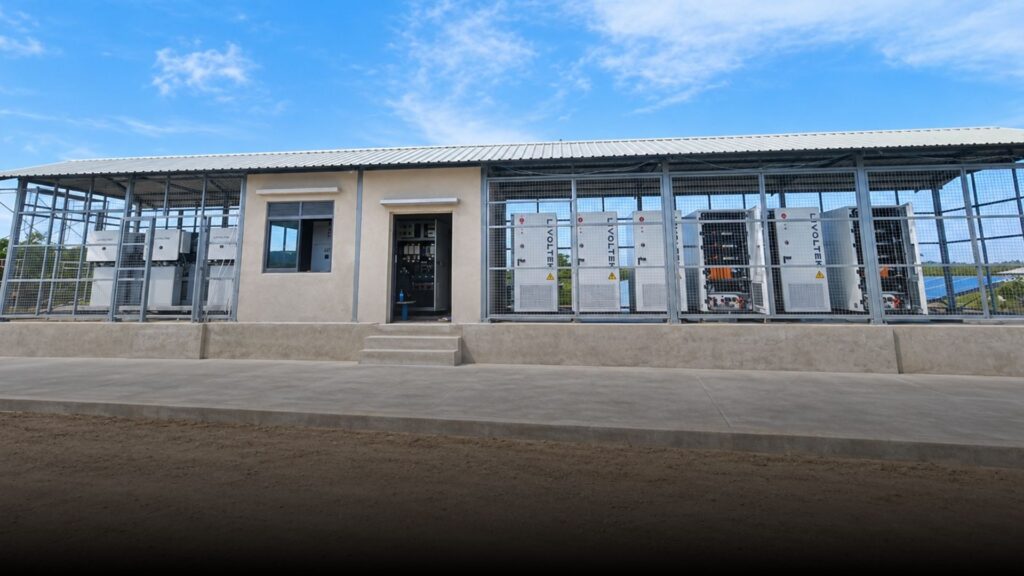
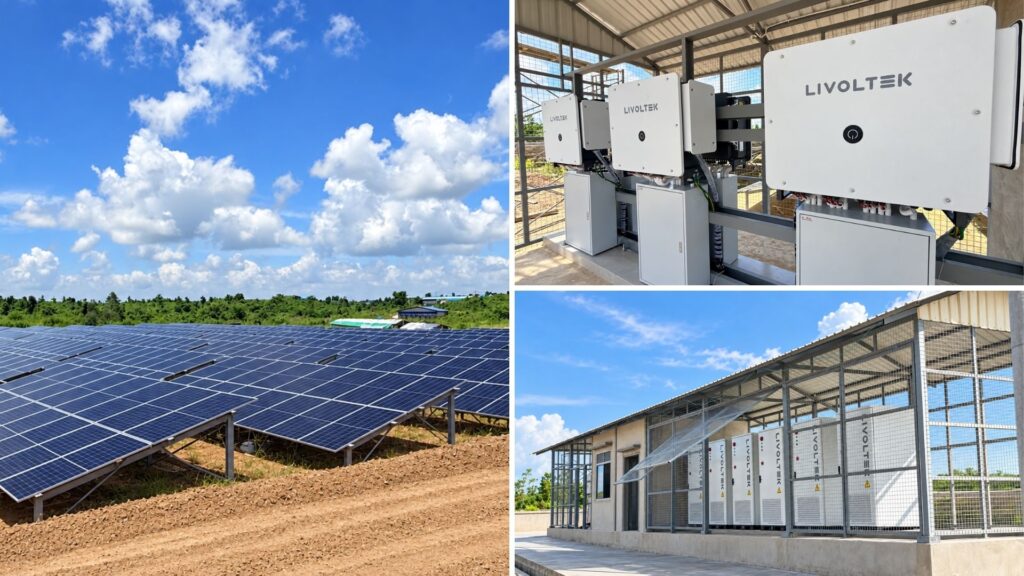
At a chicken farm in Taikkyi, unreliable grid conditions made a conventional utility connection impractical. LIVOLTEK deployed a 957.6 kWp solar system, 750 kW / 1,566 kWh of battery storage, and diesel backup to create a local off-grid microgrid for two poultry houses.
957.6 kWp PV capacity
750 kW Inverter capacity
1,566 kWh Battery storage
24/7 Power objective
Project configuration: 6 × LIVOLTEK GT3-125kW grid-tied inverters and 6 × LIVOLTEK BES-P125X261 battery energy storage cabinets, each rated at 125 kW / 261 kWh, integrated with photovoltaic generation and diesel generation for off-grid operation.
Why the farm chose an off-grid power solution
The site is located near a small local transformer with insufficient capacity for the farm’s operating needs. Voltage at the site can fall to only a little over 100 V, making the available grid connection unsuitable for reliable poultry production. Instead of depending on poor-quality grid power, the farm chose to operate more like a remote, unelectrified site: generate power locally, store it, and keep diesel generation available as backup.
This challenge is not unique to one farm. In May 2026, Myanmar’s Ministry of Electricity and Energy stated that the national power system could meet only about 70% of electricity demand. The World Bank’s October 2025 firm monitoring survey also found that 64% of surveyed firms experienced power outages, while 47% had invested in diesel generators and 32% had invested in off-grid power systems.
For businesses operating in weak-grid or effectively off-grid locations, the energy question is no longer only “How much electricity costs?” It is also “Can the site maintain continuous operation when the grid cannot?”
How the solar + BESS + diesel hybrid microgrid works
The Taikkyi project combines three complementary energy sources. Solar is the primary source during daylight hours. Battery energy storage absorbs surplus solar energy and releases it when generation falls below load demand. Diesel generation remains available as a dispatchable backup source when solar and stored energy are not sufficient.
This architecture reduces reliance on a single power source. Instead of operating diesel generators continuously, the farm can use solar energy whenever available, shift energy through the BESS, and reserve diesel for periods when additional firm power is required.
Powering critical poultry operations around the clock
The system supplies two poultry houses, with each house accommodating more than 20,000 chickens. Reliable electricity is essential because modern poultry farming depends on multiple continuous electrical loads, including automatic feeding, water supply, ventilation, and lighting.
Ventilation is particularly critical in enclosed poultry houses. A prolonged interruption can quickly affect temperature, airflow, animal health, and production conditions. By combining PV generation, battery storage, and standby diesel generation, the microgrid is designed to keep these essential systems operating around the clock.
Project system configuration

Why hybrid microgrids matter in weak-grid markets
Weak-grid regions often face a difficult trade-off. Connecting to the grid may still leave a business exposed to outages, voltage instability and limited transformer capacity, while relying only on diesel creates recurring fuel and operating costs. A hybrid microgrid gives site owners another option: combine locally generated solar with battery storage and dispatchable backup power.
This approach is particularly relevant to remote farms, food processing sites, factories, mines, telecom infrastructure, islands, construction camps and other commercial or industrial facilities where continuous power is more valuable than simple grid access.
From backup power to a site-level energy system
The Taikkyi project illustrates a broader shift in distributed energy. Solar, storage and diesel no longer need to be treated as separate pieces of equipment. When designed as one operating system, they can perform different roles across the day: solar produces low-marginal-cost energy, the BESS balances generation and load, and the generator provides additional resilience.
For commercial and industrial users, the result is not merely a backup system. It is a site-level energy architecture that can be adapted to local grid conditions, load profiles, renewable resources and reliability requirements.
FAQ: Off-grid solar + BESS + diesel microgrids
What is an off-grid solar battery diesel microgrid?
It is a local power system that combines solar PV, battery energy storage and a diesel generator without depending on the utility grid for normal operation. Solar is typically the preferred generation source, batteries balance supply and demand, and diesel provides firm backup when required.
Why use batteries if a diesel generator is already available?
Batteries can store solar energy and deliver power without starting a generator every time solar output falls. This can reduce generator runtime, improve renewable-energy utilization and provide faster power balancing for changing loads.
Which commercial sites are suitable for this architecture?
Typical applications include farms, factories, warehouses, mines, telecom sites, islands, remote facilities and other locations with unreliable grids, insufficient transformer capacity or no practical grid access.
What does the Taikkyi poultry farm system include?
The project includes 957.6 kWp of PV, six 125 kW LIVOLTEK GT3 inverters, and six 125 kW / 261 kWh LIVOLTEK BES-P125X261 battery cabinets for a total BESS rating of 750 kW / 1,566 kWh, with diesel generation available as backup.
Building resilient energy for remote and weak-grid sites
For the Taikkyi farm, the goal is straightforward: keep essential poultry operations powered 24 hours a day despite an inadequate local grid connection. By integrating solar, battery storage and diesel generation, LIVOLTEK provides a practical hybrid microgrid architecture that turns a weak-grid location into a locally managed energy system.
Explore LIVOLTEK commercial and industrial energy storage, PV inverter and intelligent energy solutions for off-grid and weak-grid applications.